
Technology Trends
IGBTs with Built-in SiC Diodes for Lower Power Consumption in Automotive and Industrial Equipment
2025.01.20
Points of this article
・To achieve carbon neutrality, power conversion systems such as DC-DC converters with further improved efficiency will be required.
・Hybrid IGBTs with integrated SiC Schottky barrier diodes can achieve both high efficiency and low cost. Such IGBT devices will enable power conversion systems that can be used in a wider range of applications.
Growing Demand for Lower Power Consumption and Redoubled Decarbonization
Modern society consumes enormous amounts of energy to produce industrial products in factories and operate industrial plants. In recent years, however, efforts to achieve carbon neutrality have accelerated rapidly around the world, and all industries are under pressure to decarbonize more effectively than ever before.
The COP26 in 2021 mandated efforts to limit the increase in global average temperature to 1.5°C above pre-industrial levels (Fig. 1). Under the Paris Agreement six years ago, 1.5°C was an effort target, but the COP26 upgraded it to a binding target. This means that all countries will be pressured to switch from fossil fuels to renewable energy. In the coming years, governments will be establishing policies and regulations to reduce emissions of greenhouse gases (GHG). In particular, vehicles and factory production, both of which currently emit large amounts of CO2, will be the primary targets for emission reductions.

Figure 1 COP26 upgraded 1.5°C effort target to a binding target.
Reflecting this situation, the introduction of “carbon pricing,” in which CO2 emissions are passed on as a cost (e.g., carbon tax), is advancing in 46 countries and 35 regions as of 2021. For global companies in particular, decarbonization efforts are now directly linked to cost competitiveness.
Urgent Need to Improve the Efficiency of Fast-Growing Power-Driven Devices
The main efforts to decarbonize are focused on the electrification of vehicles, primarily through the shift to EVs, and the greater use of electricity derived from renewable energy sources. However, it is difficult to achieve the 1.5°C target through these two approaches alone.
According to the Renewables 2021 Global Status Report, 32% of the world’s total energy consumption comes from engine-driven vehicles and other transportation equipment, while 17% comes from electrical power used in homes and factories (Fig. 2). The remaining 51% is consumed by turbines and heat treatment boilers that operate industrial plants, which burn fossil fuels to generate thermal energy. This is where decarbonization is difficult.
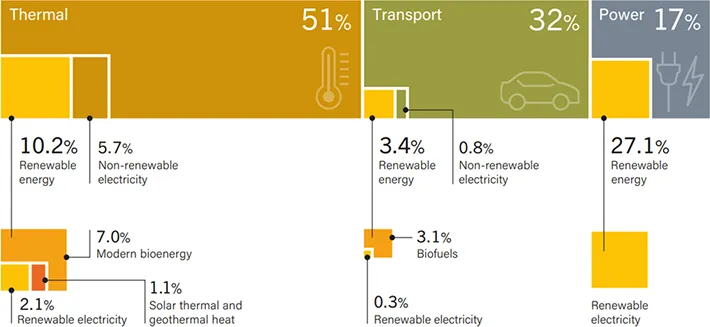
Figure 2 Electrical power accounts for 17% of the world’s total energy consumption.
Source:REN21, Renewables 2021 Global Status Report (GSR)
In the future, global decarbonization will take the form of increased use of electricity, which is easier to control in a finely tuned manner. Specifically, electrification of energy-consuming transportation equipment and thermal energy applications will accelerate. In general, engines, turbines, and boilers are difficult to stop once started, whereas electricity-driven motors and thermal heaters can be easily stopped or started depending on usage. Efficiently running equipment only when necessary can promote power savings. As a result, there will be an increase in electric-power-driven equipment and plants, especially those that can run with high power efficiency.
A wide variety of power conversion systems, such as onboard chargers and DC-DC converters, are installed in electrified vehicles (xEVs), industrial motor drivers, power conditioners for solar power plants, and control devices for industrial equipment and plants. Power conversion always involves some power loss, and the conversion efficiency of DC-DC converters is generally 80-95%. Even if the amount of loss during a single power conversion is small, about one-third of the power generated in a power plant is lost as heat and electromagnetic radiation before it is actually used. This loss is compensated for by the expansion of power plants. Minimizing these losses is important to promote decarbonization.
High power efficiency solutions must also have appropriate costs. Otherwise, applications will be limited and total power reduction will not be possible.
Hybrid Devices as a Solution Using Low-Loss SiC Devices
There are two methods for reducing power losses in a power conversion system: improving the configuration of conversion circuits, and using power devices with low losses during operation.
Recently, silicon carbide (SiC) based power devices have emerged as next-generation low-loss devices. SiC devices have lower on-resistances than Si devices and offer superior performance in high-temperature, high-frequency, and high-voltage applications. These features make SiC devices suitable for use in automotive and industrial power conversion systems, which are often used in harsh environments.
In fact, SiC devices are increasingly being used in DC/AC converters for solar and wind power generation facilities, onboard chargers and power converters for electric or hybrid vehicles, power inverters and power supplies for industrial equipment, and energy storage facilities. ROHM offers SiC Schottky barrier diodes (SBDs) with voltage ratings of 650 V/1200 V and SiC MOSFETs rated at 650 V/750 V/1200 V/1700 V in volume production.
Most power conversion systems today use Si-based IGBTs or Super Junction MOSFETs (SJ-MOSFETs) as switching elements. IGBTs have the advantage of low production cost, but when used with inductive loads such as motors and coils, they require a freewheeling diode. In addition, they generally have high turn-off losses. On the other hand, SJ-MOSFETs have low turn-off losses but cannot easily handle high power. If SiC MOSFETs and SiC SBDs are used in combination instead of IGBTs and SJ-MOSFETs, conversion efficiency can be dramatically reduced. At present, however, SiC wafers are still more expensive, limiting their application.
In order to promote decarbonization, a power conversion solution that has a wider range of applications and combines high efficiency with low cost is indispensable. ROHM has now developed a hybrid IGBT solution, which combines the features of both low-cost IGBTs and high-efficiency SiC devices. This breakthrough solution uses an SiC SBD as an IGBT freewheeling diode to significantly reduce turn-on loss. By improving the turn-off characteristics of the freewheeling side device (low side) in a half-bridge configuration, turn-on loss in the switching side device (high side) can be improved. Furthermore, the use of IGBTs, which are less expensive than SiC MOSFETs, as the switching element reduces costs and enables a wider range of applications.
ROHM Hybrid IGBT Performance and Advantages of Adoption
To obtain higher conversion efficiency, it is necessary to use a freewheeling diode that matches the characteristics of the IGBT. The ROHM’s RGWxx65C series of products are hybrid IGBTs with 650 V voltage ratings. These devices integrate the characteristics of IGBTs and SiC SBDs in a single package. Since the areas requiring the most precise circuit design are optimized at the device level, users can easily configure cost-effective power conversion systems.
When the RGWxx65C series is used in an onboard charger, losses can be reduced by 67% compared with conventional IGBTs and by 24% compared with SJ-MOSFETs (Fig. 3). In addition, a high conversion efficiency of over 97% can be ensured over a wide range of operating frequencies, and at an operating frequency of 100 kHz, the efficiency can be increased by 3% compared to that of conventional IGBTs. Moreover, this can be achieved simply by replacing the IGBT-based circuits currently used. The hybrid IGBTs are compliant with the AEC-Q101 automotive reliability standard, ensuring worry-free use even under severe conditions.
ROHM’s hybrid IGBTs are highly effective devices that can contribute to further decarbonization in various industrial fields, including the automotive industry.
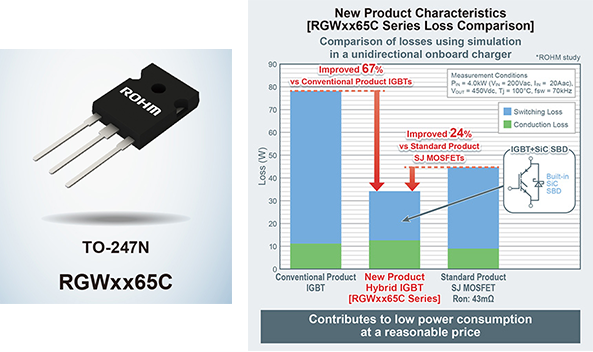
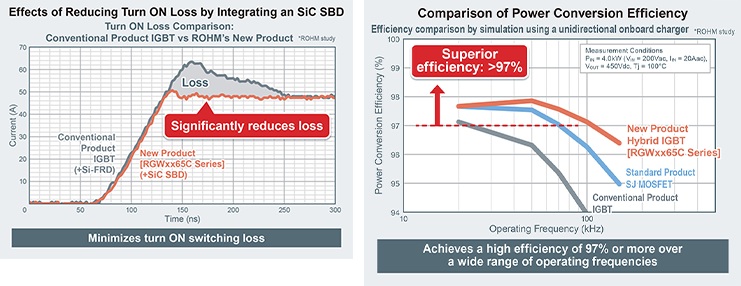
Figure 3
ROHM RGWxx65C Series Lineup
| Part No. | Voltage ratings \( V_{CES} \)(V) |
Collector current \( I_C \)@100℃ (A) |
Conduction loss \( V_{CE(\text{sat})} \) Typ(V) |
Freewheeling diode |
AEC-Q101 compliant |
Package |
|---|---|---|---|---|---|---|
| RGW60TS65CHR | 650 | 30 | 1.5 | SiC SBD | YES | TO-247N |
| RGW80TS65CHR | 40 | |||||
| RGW00TS65CHR | 50 | |||||
| ☆ RGW40NL65CHRB |
20 | TO-263L (LPDL) 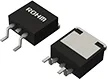
|
||||
| ☆ RGW50NL65CHRB |
25 | |||||
| ☆ RGW60NL65CHRB |
30 |
☆ Under development.
Packages use JEDEC notation.
Items within parentheses indicate ROHM packages.
* In addition to the above Hybrid IGBTs, we offer products using Si-FRDs as freewheeling diodes and products without freewheeling diodes. Click on the URL below for more information.
https://www.rohm.com/products/igbt/field-stop-trench-igbt?page=1&SearchWord=rgw
Articles Related to IGBT with Built-In SiC Diode
【Download Documents】 Basics of SiC Power Devices
This handbook explains the physical properties and advantages of SiC, the differences in characteristics and usage of SiC Schottky barrier diodes and SiC MOSFETs with a comparison to Si devices, and includes a description of full SiC modules with various advantages.

Technology Trends
-
IGBTs with Built-in SiC Diodes for Lower Power Consumption in Automotive and Industrial Equipment
-
AC-DC Converter IC Incorporating 1700 V SiC MOSFET Supports Further Moves Toward ”Smarter” Plants
-
Fifth-Generation Planar Schottky Barrier Diodes Enable Lower Power Consumption of Electronic Equipment
-
Supplying Stabilized Power Supplies for Automotive Systems in the CASE Era: DC-DC Converters with Enhanced Load Response Performance through Proprietary Technology