D/A Converters|Basic
D/A Converter <What are D/A converters?>
table of contents
D/A Converters
D/A converters convert digital signals into analog format.

- Digital Data:
- Evenly spaced discontinuous values
Temporally discrete, quantitatively discrete - Analog Data (Natural Phenomena):
- Continuous range of values
Temporally continuous, quantitatively continuous
Basic Operation of a D/A Converter
A D/A converter takes a precise number (most commonly a fixed-point binary number) and converts it into a physical quantity (example: voltage or pressure). D/A converters are often used to convert finite-precision time series data to a continually varying physical signal.
An ideal D/A converter takes abstract numbers from a sequence of impulses that are then processed by using a form of interpolation to fill in data between impulses. A conventional D/A converter puts the numbers into a piecewise constant function made up of a sequence of rectangular functions that is modeled with the zero-order hold.
A D/A converter reconstructs original signals so that its bandwidth meets certain requirements. With digital sampling comes quantization errors that create low-level noise which gets added to the reconstructed signal. The minimum analog signal amplitude that can bring about a change in the digital signal is called the Least Significant Bit (LSB), while the (rounding) error that occurs between the analog and digital signals is referred to as quantization error.
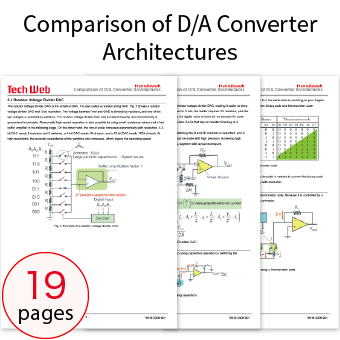
【Download Documents】 Comparison of D/A Converter Architectures ― Circuit Configurations, Features, and Points to Note, from the Basics ―
This handbook brings together the basic D/A converter articles on TechWeb in a single volume, reorganized around comparing architectures. It explains how methods using resistors, capacitors, current sources, and oversampling differ, and covers the three basic configurations (the decoder, binary, and thermometer code methods) with example circuits. A table comparing the three basic configurations in terms of circuit scale, precision, speed, and glitches is also included.