D/A Converters|Basic
A/D and D/A Requirements
table of contents
Electrically sophisticated and high-speed processing are performed digitally in CPUs and DSPs.
Natural phenomena are converted to digital signals using an A/D converter for digital signal processing, then converted back to analog signals via a D/A converter.
Advancements in Microfabrication Technology→Signal Processing Digitization
→A/D and D/A Converters Required

A/D Converter Applications
- Digital Audio:
- Digital audio workstations, sound recording, pulse-code modulation
- Digital signal processing:
- TV tuner cards, microcontrollers, digital storage oscilloscopes
- Scientific instruments:
- Digital imaging systems, radar systems, temperature sensors
D/A Converter Applications
- Digital Audio:
- CD, MD, 1-bit Audio
- Digital Video:
- DVD, Digital Still Camera
- Communication Equipment:
- Smartphones, FAX, ADSl equipment
- PCs:
- Audio, video cards
- Measurement instruments:
- Programmable power supplies, etc.
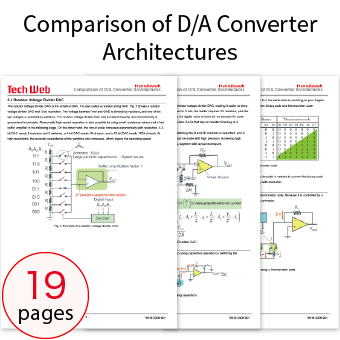
【Download Documents】 Comparison of D/A Converter Architectures ― Circuit Configurations, Features, and Points to Note, from the Basics ―
This handbook brings together the basic D/A converter articles on TechWeb in a single volume, reorganized around comparing architectures. It explains how methods using resistors, capacitors, current sources, and oversampling differ, and covers the three basic configurations (the decoder, binary, and thermometer code methods) with example circuits. A table comparing the three basic configurations in terms of circuit scale, precision, speed, and glitches is also included.