Transfer Function|
State-Space Averaging Method - Dynamic Analysis
2017.09.21
Points of this article
・The dynamic state quantities Δvout/ΔD and ΔIL/ΔDare derived from equations obtained by state averaging.
In the previous section, we performed a static analysis using equations derived by “state averaging”. This time, we will perform a dynamic analysis in order to derive , which is an objective of state averaging. Please read this in conjunction with the discussion of static analysis in the preceding section.
Dynamic Analysis
Below are the previously derived equations relating to coil current and capacitor charge. They have appeared a number of times by now, but if the premises on which they are based are not kept in mind, solving the equations becomes difficult.
The same procedures are used with both equations, but here they are presented separately.
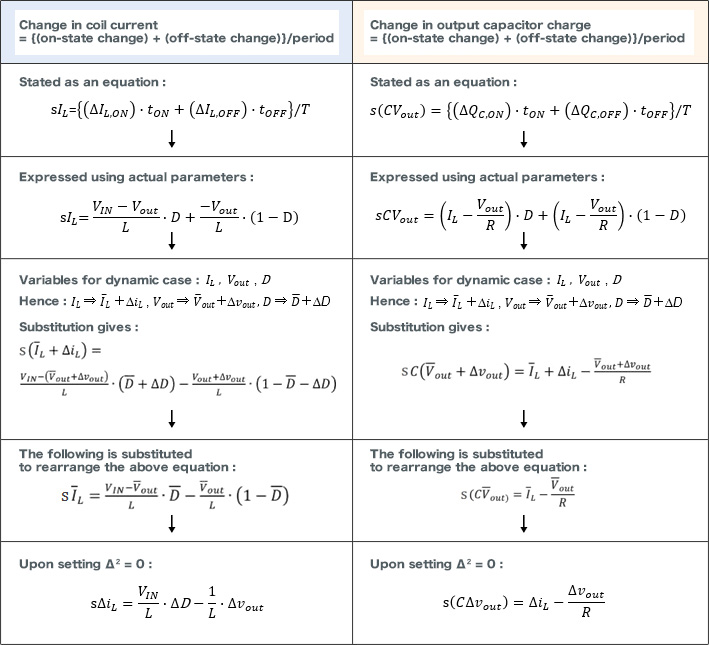
Upon solving the last equations simultaneously, can be determined. The equations are rewritten as follows.
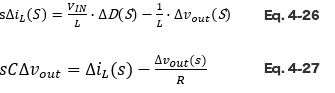
Next time, we will consider the derivation of these equations from a somewhat different perspective.
【Download Documents】 How to Derive Transfer Functions: Basic Equations Quick Reference
This handbook explains how to derive transfer functions, starting with basic equations and an RC low-pass circuit. It covers gain and phase, functional block decomposition of DC-DC converters, voltage- and current-mode control, and derivation procedures using state-space averaging. It also summarizes subharmonic oscillation and slope compensation, with links to TechWeb articles for detailed derivations.