
Diodes|Basic
What Is a Diode? How It Works, Types, and Applications
2026.05.13
A diode is a two-terminal semiconductor device that allows current to flow in essentially one direction only. In the forward direction, current flows from the anode to the cathode; in the reverse direction, current is blocked except for a small leakage current.
Thanks to this property, diodes are used in a wide range of applications, including rectification (converting AC to DC), reverse-current protection, overvoltage protection, signal detection, and switching. Typical types include rectifier diodes, switching diodes, Schottky barrier diodes, Zener diodes, TVS diodes, and LEDs (light-emitting diodes).
This article explains the fundamentals of diodes: their basic structure and operating principle, circuit symbol and current direction, voltage-current characteristics, the features of each type, and their main applications.
Structure and Operation of a Diode
Diodes rely on the pn junction, which unites p-type material (rich in holes) with n-type material (rich in electrons). At the boundary, carriers combine and form a depletion region that impedes electron flow. In certain conditions, a diode can act as a one-way gate, allowing electric current to flow readily in the forward-biased direction but clamping down when reverse-biased. This is one reason they’re so popular for rectifier circuits and other electronic devices that require unidirectional current.
Role of a Diode
Think of a semiconductor diode as a one-way valve made from p-type and n-type material. When you bias it with a positive voltage on the anode lead (forward-biased), the internal barrier reduces, current ramps up, and electron flow becomes significant. Reverse the voltage, and the barrier widens—significantly reducing current in the opposite direction.
In practice, a typical silicon diode often needs about 0.7V of anode voltage over the cathode to conduct meaningfully (its forward voltage drop). That threshold voltage shapes design decisions in rectifier diodes, LED drivers, and more.
A diode symbol on a schematic emphasizes this one-directional property, with the cathode voltage side blocking current under reverse bias.
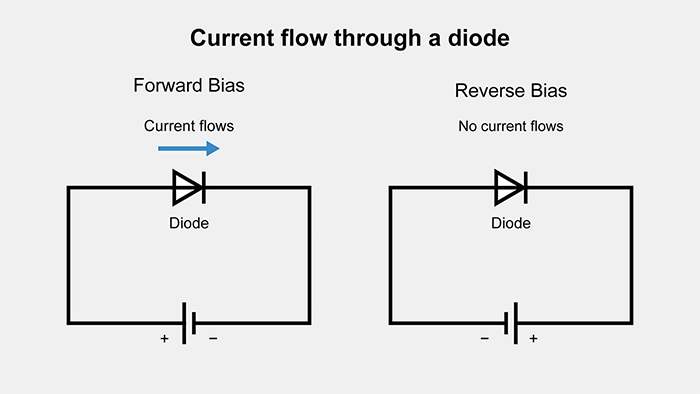
Explanatory Notes
Because these pn junction devices permit current to flow in only one direction, you can protect circuits from harmful reverse current or convert AC to DC for power supplies. The small forward-voltage drop of silicon diodes (roughly 0.7V) is often manageable, though specialized types such as Schottky diodes lower it further.
pn Junction and Depletion Region
At the interface of a p-type semiconductor (holes as majority carriers) and an n-type material (electrons as majority carriers), charges diffuse across, leaving behind fixed ions that form a depletion region.
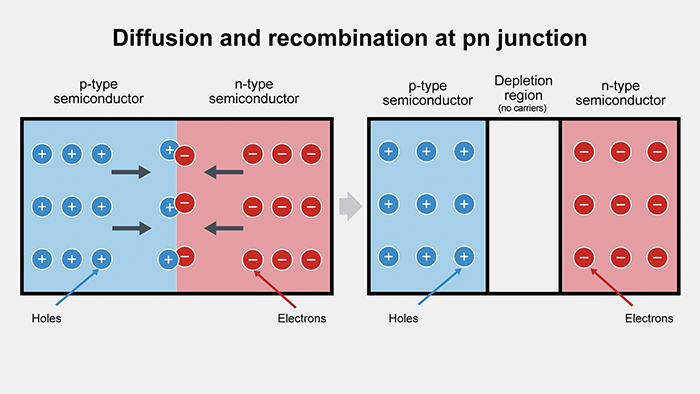
When the diode is forward-biased, the external voltage shrinks this region, allowing carriers to recombine freely and allowing current to flow in one direction. But if you reverse-bias the diode, the depletion region expands, making current flow nearly zero in that reverse direction.
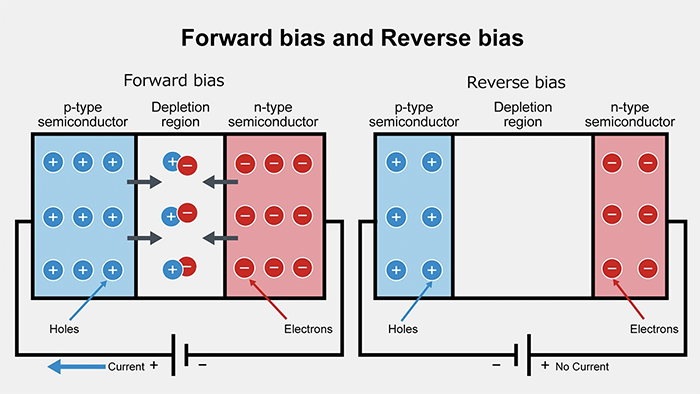
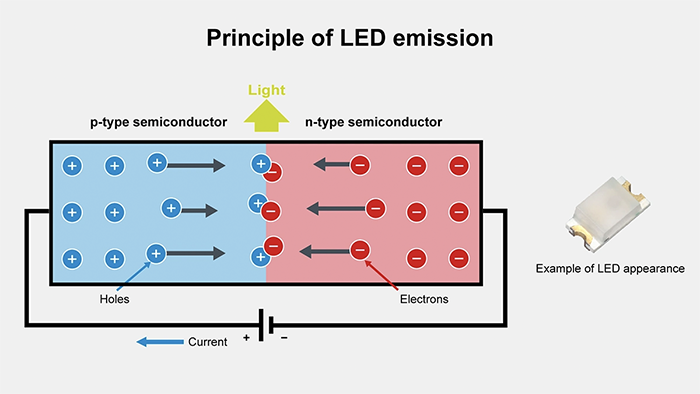
Light-emitting diodes (LEDs) are a notable example: forward-bias them with a suitable input voltage, and they emit visible light or even infrared light. Reverse bias yields no glow and almost no current. A PIN diode (with intrinsic material sandwiched between p- and n-type layers) likewise leverages this same principle, though it’s better suited for high-frequency or RF applications.
Threshold Voltage and Breakdown Voltage
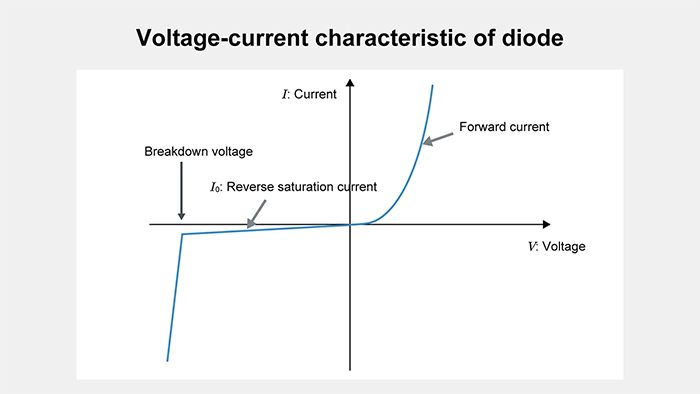
Under forward bias, a diode must reach a certain threshold voltage (often around 0.7V for silicon diodes, ~0.3V for germanium diodes, or as low as 0.2–0.4 V for a Schottky diode) before strong conduction sets in. This forward voltage drop is key to understanding power losses or the headroom needed in low-voltage circuits.
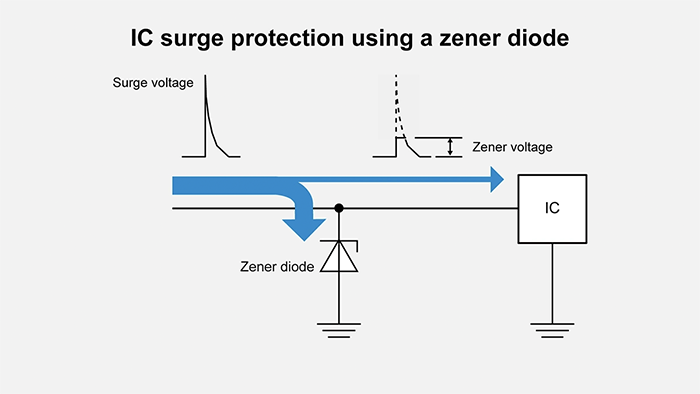
In reverse bias, if the reverse voltage surpasses a certain breakdown voltage, avalanche diode action can occur—some diodes can withstand high voltages at breakdown. However, it’s not always desirable unless the device is built for it. Zener diodes exploit a precisely controlled breakdown region (the zener voltage) to maintain a near-constant voltage, making them handy for establishing a stable reference voltage or protecting an input from an overvoltage surge.
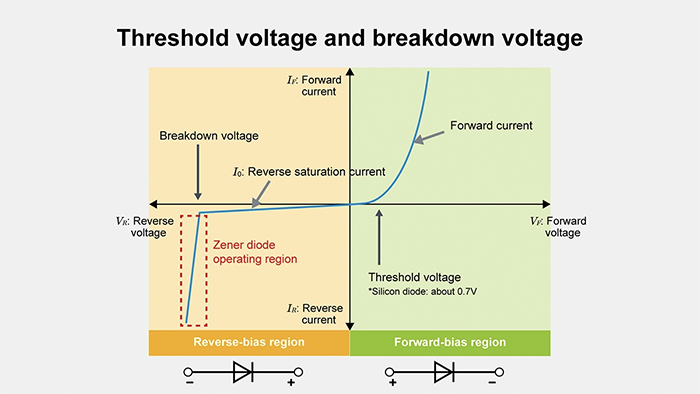
Diode Voltage-Current Characteristics
Quantifying a diode’s behavior across different voltage ranges is crucial for designing electronic circuits. Whether you’re dealing with power supplies or high-speed switching stages, you want to know how the diode’s conduction path, reverse current, and forward voltage drop affect efficiency and thermal performance. We’ll look at the Shockley diode equation as a foundational model, then note how temperature, parasitic elements, or large input voltage swings can alter real-world operation.
Shockley Diode Equation
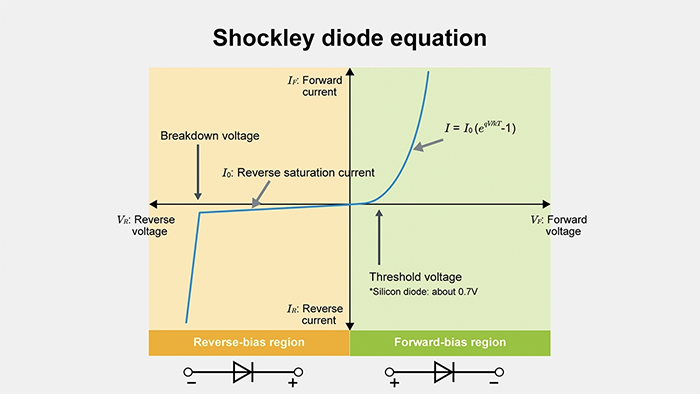
A pn junction diode’s voltage-current characteristic often follows:
\(I=I_0 \left(e^{\frac{qV}{kT}}-1\right)\)
- I is the diode current
- I0 is the reverse saturation current
- q is the electronic charge (about 1.602 × 10⁻¹⁹ coulombs)
- V is the voltage across the diode
- k is the Boltzmann constant (about 1.38 × 10⁻²³ J/K)
- T is the absolute temperature (K)
Once the input voltage crosses the threshold, current grows exponentially. This explains why a diode may appear “off” below a certain forward voltage drop, then switch “on” rapidly above it. In real circuits, we must also account for series resistance, junction capacitances, and temperature effects, which is why advanced SPICE models or data sheet graphs are a practical fallback for final design checks.
Temperature Effects and Practical Considerations
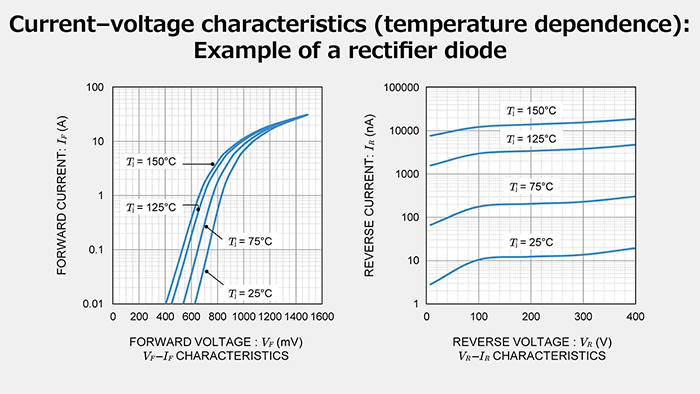
As junction temperature rises, a silicon diode’s forward voltage drop decreases, which can increase current flow—leading to self-heating and potentially a runaway if not managed. In a rectifier circuit for a power supply, for instance, each diode must handle direct current surges and dissipate heat properly. Designers often need heatsinks or air cooling if the device is expected to carry high current.
Soldering or reflow processes also stress diodes. You want to ensure each semiconductor diode package can withstand the thermal profile during assembly while maintaining its performance. Regardless of your scale—whether a hobby project or a professional product—understanding these temperature dependencies and ensuring safe margins for the diode fosters more reliable operation across the entire voltage range you might encounter.
Types of Diodes
Although the classic pn junction diode is typical, you can find a broad spectrum of semiconductor devices for various tasks. Some are specialized for a lower forward-voltage drop, others act as constant-voltage references, and still others, like laser diodes, emit coherent light. This variety lets engineers choose the exact diode function for each application—whether protecting a negative terminal from an unintended polarity or generating visible light for an indicator.
Diode Classifications
Broadly, diodes split into functional categories such as rectifier diodes for power conversion, zener diodes for voltage regulation, Schottky diodes with low forward drop and fast switching, or LEDs and laser diodes for emitting light. Beyond that, each family branches into numerous voltage ratings, current capacities, and package styles, ranging from tiny signal diodes that handle milliamps to robust diodes capable of withstanding high voltages in harsh environments.
Understanding these classifications—whether it’s a germanium diode for a lower threshold, a PIN diode for RF switching, or a constant-current diode for controlling current flow—will guide you to the best choice for your circuit’s needs.
| Use | Type | Structure |
|---|---|---|
| Rectification | Rectifier Diodes | pn junction |
| Switching Diodes | pn junction | |
| First Recovery Diodes(FRD) | pn junction | |
| Diodes Bridges | pn junction | |
| Step Recovery Diode(SRD) | pn junction | |
| Schottky Diodes | Metal-Semiconductor junction | |
| SiC Schottky Diodes | Metal-Semiconductor junction | |
| Constant voltage | Zener Diodes | pn junction |
| ESD Protection Diodes(TVS) | pn junction | |
| Avalanche Diodes(ABD) | pn junction | |
| High frequency | Band Switching Diodes, PIN Diodes | pn junction |
| Detection Schottky Diodes | Metal-Semiconductor junction | |
| Variable Capacitance Diodes | pn junction | |
| Constant current | Current Regulative Diodes | Junction FET (JFET) |
| Light emission | Light Emitting Diodes(LED) | pn junction |
| Laser Diodes(LD) | pn junction | |
| Light reception | Photodiodes | pn junction |
General-Purpose (Rectifier) Diodes
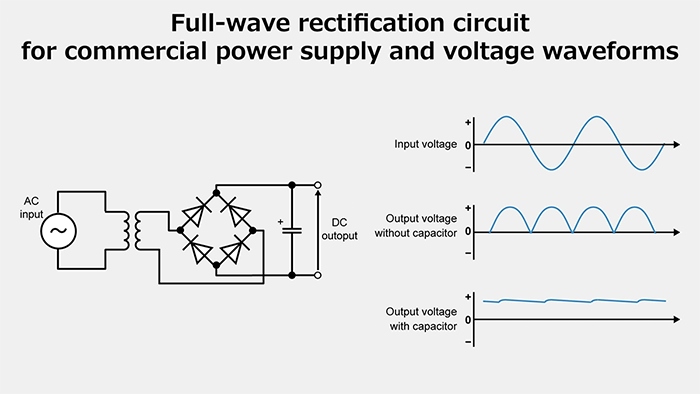
In rectifier circuits used with household AC mains and industrial power supplies, general-purpose rectifier diodes are widely used. A typical rectifier circuit might use four diodes in a full-bridge configuration, flipping the negative half-waves. Hence, the output remains positive at the terminal relative to the negative lead. That direct current can then be stored in capacitors or fed into regulators.
Because each diode contributes a forward voltage drop—often about 0.7V in silicon diodes—you’ll see some power loss. For higher efficiency or lower voltage rails, Schottky diodes might be preferred. Either way, watch out for surge current when large filter capacitors charge up, and ensure the diode can handle it within the device’s safe operating area.
Zener Diodes
A zener diode is basically a pn junction diode designed to maintain a stable reference voltage once reverse-biased beyond its zener voltage. That constant voltage proves useful in low cost regulators or as a clamp that protects circuits from unexpected spikes. Zener diodes are available across different voltage ranges.
In a typical scenario, you wire a zener across the load so that if the input voltage drifts too high, the diode conducts in reverse bias, holding the node near a desired threshold voltage (like 5.1 V or 12 V). Of course, that conduction can generate heat, so you must size the resistor and verify that the diode can withstand the worst-case power dissipation.
Schottky Diodes
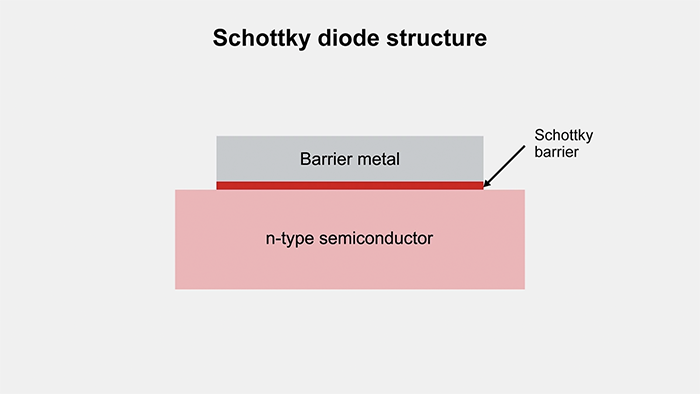
A Schottky diode uses a metal–semiconductor junction rather than a pn junction. This yields a lower forward voltage drop—maybe 0.2–0.4V—and faster reverse recovery, making Schottky diodes valuable for high frequency or low voltage supply lines. They often show up on the secondary side of switch-mode power supplies, where that drop advantage can significantly reduce losses.
On the flip side, many Schottky diodes have a relatively modest reverse voltage limit, so they’re not always suitable if you need to withstand high voltages. Nonetheless, in 5V or 3.3V rails, or OR-ing multiple power sources, Schottky diodes often shine, providing more efficient conduction and protecting each source from reverse current.
LED
A light-emitting diode (LED) is a diode that radiates visible light (or infrared, UV) when forward-biased. You’ll see it everywhere, from small indicator lamps to automotive headlamps. Because LED forward voltages vary—red might be around 1.8–2.2 V, while blue or white can top 3 V—designers typically include a series resistor or a constant-current driver to regulate current and prevent damage.
Unlike a standard rectifier diode, an LED is specifically built so carriers readily emit electrons as photons when they recombine. This property transforms electric current into optical output. You can find them in laser diode variants too, which focus and amplify that light for precise beams, widely used in everything from optical drives to telecommunications.
Major Applications and Uses of Diodes
Far beyond just rectifying AC into DC or clamping a voltage, diodes show up in a variety of ways to shape waveforms, protect sensitive ICs, or even generate coherent laser beams. Below are a few glimpses into how each type can provide a unique diode function in electronic circuits, from power regulation and voltage regulators to advanced signal processing.
Rectifiers in Power Supplies
One of the most common uses for diodes is to convert AC from a wall source to a DC rail. By wiring diodes in a bridge, you can ensure that current flows in only one direction to your load, filtering out negative voltage swings. That direct current can then feed voltage regulators or a bigger DC–DC converter. If you want lower forward losses, you might switch to Schottky diodes, especially at lower voltages.
At startup, big capacitors can draw large inrush currents, so your diodes must handle the surge without failing. Reading data sheets for maximum forward current and verifying thermal constraints are essential steps for a robust design.
Protection and Surge Suppression
In many electronic circuits, diodes guard against potentially damaging reverse voltage or transients. For instance, placing a diode across an inductive coil—such as a motor or relay—lets the current dissipate safely rather than creating a harmful voltage spike when the coil is switched off. This is often called a freewheel diode or flyback diode.
Similarly, zener diodes clamp input voltage so that sensitive sections in the circuit never exceed a chosen limit. ESD protection diodes appear across signal lines to route static discharge to a safe ground path. Whether it’s controlling a motor or shielding a microcontroller pin, “diode to the rescue” is a common design approach.
Signal Processing and Communication Circuits
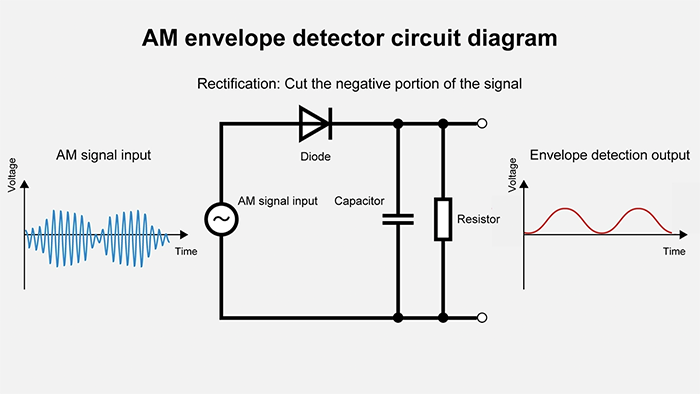
In communication and audio electronics, diodes serve to demodulate signals or reshape waveforms. An AM demodulator uses a diode to separate the audio signal from its carrier. Meanwhile, clipper and clamper circuits rely on diodes to keep voltage swings within set bounds or shift the waveform’s baseline.
In more advanced high-frequency applications, PIN diodes enable fast switching or attenuation, and varactor diodes (a specialized pn junction diode) adjust circuit capacitance under bias for voltage tuning. Each type of diode operates by controlling electron flow—blocking or allowing current only when you want it.
Keyboard Matrix Circuits and More
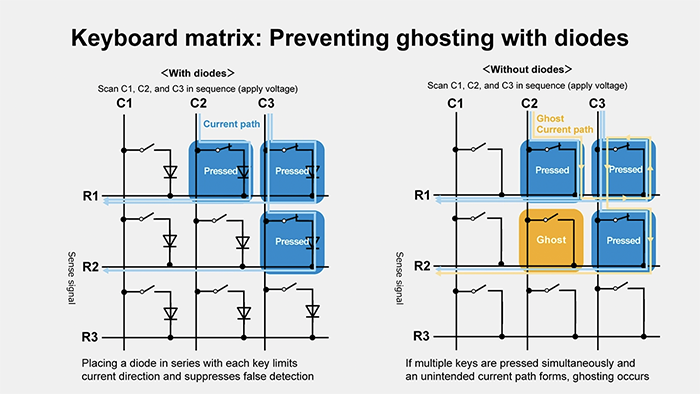
In a keyboard matrix, diodes can help isolate each switch, so pressing multiple keys at once doesn’t cause undesired cross-currents or “ghost” keypresses (a phenomenon in which a key that was not pressed is mistakenly detected as pressed). Voltage multiplier circuits, which employ diodes and capacitors in stages, can generate higher direct current voltages from a relatively modest AC input voltage, suitable for certain specialized or lab-style high-voltage testers.
Some designs incorporate “OR-ing” diodes to let two power supplies feed a single load without back-driving the other supply, making sure current can flow from whichever source is higher while protecting the lower source from reverse current. In short, diodes remain essential for controlling direction, magnitude, and conduction paths throughout electronic circuits.
Summary
Diodes are fundamental semiconductor devices that allow current to flow in only one direction—an invaluable trait for everything from rectifying AC waveforms and providing a constant-voltage reference to protecting delicate electronics from voltage spikes or negative lead connections. By understanding the roles of each diode type—be it a standard rectifier diode, a zener diode maintaining a stable reference voltage, a Schottky diode offering a lower forward voltage drop, or a laser diode emitting highly focused light—you can better match your design requirements to the right piece of hardware.
Appreciating the fundamentals—pn junction physics, depletion-region behavior, forward-voltage drop, reverse-voltage tolerance, avalanche diode breakdown, and so on—ensures your circuits remain robust, efficient, and safe. Whether dealing with direct current rails in power supplies, reverse-biased clamp sections, or the visible light from an LED, diodes keep electronic circuits running smoothly.
Related article
What is a pn junction?
【Download Documents】 Transistors & Diodes Basics and Selection
In this handbook, although there are so many types of power devices using Si semiconductors, the basic points are explained, focusing mainly on diodes and transistors for power supply applications. It also introduces the procedure and decision method for transistor selection when designing circuits, as well as application examples that utilize each characteristic and feature.
Diodes
Basic
-
Diode Articles
- What is a pn junction?
- What Is a Diode? How It Works, Types, and Applications
- Rectifier Diodes
- Switching Diode
- Schottky Diode (Schottky Barrier Diode)
- Zener Diode
- TVS Diodes
- PIN Diodes
- Diode Types and Characteristics: Static and Dynamic Characteristics, Current, Voltage, and Reverse Recovery Time
- Comparing Rectifier, Switching, Schottky, and Fast Recovery Diodes
- Schottky Diode Characteristics and Thermal Runaway
- Fast Recovery Diode (FRD) Characteristics
Evaluation