
Motor|Basic
Driving Brushed DC Motors with an H-Bridge:High-Side Voltage Linear Control
2022.07.06
Points of this article
・A circuit is configured to enable linear control of the H-bridge circuit high-side voltage.
・By controlling the H voltages of OUT pins, linear control of the rotation rate/torque of the motor is possible.
Starting with this article, a number of methods for driving brushed DC motors using an H-bridge circuit are explained.
Driving Brushed DC Motors with an H-Bridge:
High-Side Voltage Linear Control
In this driver circuit example, the voltage applied to a motor is controlled with the H voltage of the OUT terminals made variable, by linear control of high-side P-channel MOSFETs. The H voltage of the OUT terminals is controlled by the DC voltage applied to the Vref terminal; theoretically the voltage is the same as the voltage applied to the Vref terminal. As a result, the motor rotation rate/torque can be controlled.
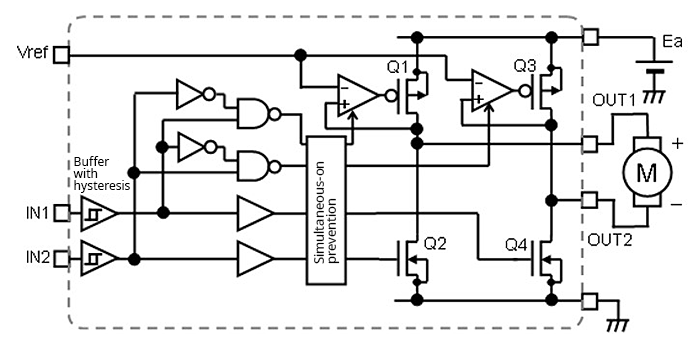
In this example, when the H-bridge switching control logic turns on the high-side MOSFETs (Q1, Q3), op-amps apply a bias to the high-side MOSFET gates to turn on the MOSFETs, and the MOSFET drain voltages are fed back to the non-inverting inputs of the op-amps. In accordance with the principles of op-amp feedback circuits, in this circuit, feedback control is performed such that the voltages at the inverting input and the non-inverting input are equal. In this example, the voltage applied to the Vref pin, which is the voltage at the op-amp’s inverting input terminal, is equal to the H voltage of the OUT terminal, which is the MOSFET drain voltage and the voltage at the op-amp’s non-inverting input terminal. The gain of this feedback circuit is +1, and therefore the voltage ratio of Vref to OUT is 1:1.
The reader may find it strange that feedback is applied to the non-inverting input terminal; but because a P-channel MOSFET is active-low, the inverted voltage of the op-amp output is fed back. The general idea is the same as for a feedback circuit that uses PNP transistors as boosters.
The operation of the H-bridge control circuit is the same as that explained in “Switching Output States”.
【Download Documents】 Basics of Brushed DC Motors and Drive Methods
Brushed DC motors are the most versatile motors and are used in a great many applications. This handbook provides the basics of brushed DC motors, explaining their construction, principle of operation, characteristics, and driving methods.

Motor
Basic
-
Brushed DC Motor
- Construction of Brushed Motors
- Principle of Rotation
- Power Generation Principle
- Short Braking
- Characteristics of Brushed DC Motors
- Driving Brushed DC Motors with an H-Bridge:Principles
- Driving Brushed DC Motors with an H-Bridge:Switching Output States
- Driving Brushed DC Motors with an H-Bridge:High-Side Voltage Linear Control
- Driving of Brushed DC Motors Using BTL Amplifier Circuits: Linear Voltage Driving
- Driving of Brushed DC Motors Using BTL Amplifier Circuits: Linear Current Driving
- Driving Brushed DC Motors Using PWM Output: Principles of PWM Driving
- Driving Brushed DC Motors Using PWM Output: Current Regeneration Methods in PWM Driving
- Driving Brushed DC Motors Using PWM Output: Losses and Points to be Noted
- Driving Brushed DC Motors Using PWM Output: PWM Driving with an H-Bridge Circuit
- Driving Brushed DC Motors Using PWM Output: H Bridge Constant-Current Driving
- Driving Brushed DC Motors Using PWM Output: Driving in the Form of BTL Amplifier Input
- Single-Switch Circuit Driving and Half-Bridge Circuit Driving
- Driving Circuits for Brushed DC Motors – Summary
-
Stepping Motors
- Structure of Stepping Motors
- Basic Operating Principles of Stepping Motors
- Stepping Motors: Microstep Operation Principles
- Basic Characteristics of Stepping Motors
- Structure and Operating Principles of Hybrid Type Stepping Motors
- Stepping Motor Driving: Bipolar Connections and Unipolar Connections
- Driving 2-Phase Bipolar Stepping Motors: Part 1
- Driving 2-Phase Bipolar Stepping Motors: Part 2
- Driving 2-Phase Unipolar Stepping Motors
- Stepping Motors – Summary
-
3-Phase Brushless Motors
- Structure of 3-Phase Full-Wave Brushless Motors
- Principles of Rotation of 3-Phase Full-Wave Brushless Motors
- Position Detection in 3-Phase Full-Wave Brushless Motors
- Driving 3-Phase Full-Wave Brushless Motors: 120° Commutation Linear-Current Driving with Sensors
- Driving 3-Phase Full-Wave Brushless Motors: Sinusoidal Commutation PWM Driving with Sensors
- Driving 3-Phase Full-Wave Brushless Motors: Advance Angle Control
- Driving 3-Phase Full-Wave Brushless Motors: Maximization of Motor-Applied Voltage
- Driving 3-Phase Full-Wave Brushless Motors: Sensorless 120° Commutation Driving
- Methods of Sensorless 120° Commutation Driving Startup 1: Startup on Detection of Induced Voltage from Synchronous Operation
- Methods of Sensorless 120° Commutation Driving Startup 2: Startup on Detection of Permanent Magnet Stopped Position
- Features and Applications of 3-Phase Full-Wave Brushless Motors ーSummaryー
- What is a Motor?