
Electrical Circuit Design|Basic
Boundary Current Mode (BCM) PFC: Examples of Efficiency Improvement Using Diodes
2018.08.23
Points of this article
・In boundary current mode PFC, the diode VF has a major effect on losses, whereas the effect of the diode trr is small.
・In PFC under boundary current mode control, by selecting a diode with a low VF, circuit efficiency can be improved.
In actual application circuits, diodes and transistors must be used selectively according to differences in their characteristics and performance. The main objective of selective use in power applications is to improve efficiency. In this article, we present an example of efficiency improvement in boundary current mode PFC (power factor correction) through differences in diode characteristics. Regarding PFC, see the explanation in the previous article.
Boundary Current Mode PFC: Example of LCD TV Circuit
This circuit is the PFC section of an LCD TV, and is an example of a single PFC boundary current mode (BCM) control method. The PFC circuit diode D1 is a fast-recovery diode (hereafter “FRD”).
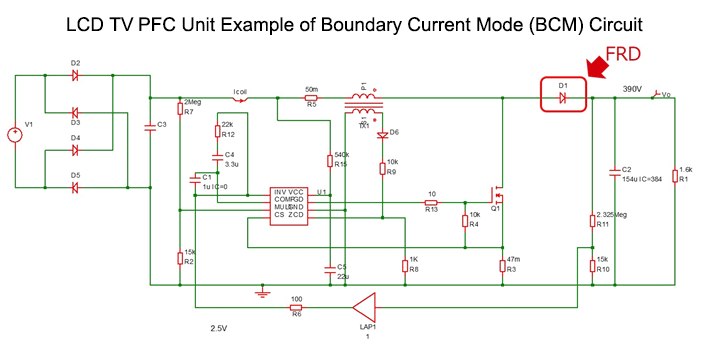
Loss simulations were performed for cases in which, a diode with low forward voltage VF, and a diode with a fast reverse recovery time trr were used. The main specifications of the two types of diode used are shown below. Specifications other than VF and trr were essentially the same.
| RFNL10TJ6S Low VF | RFV8TJ6S Fast trr | Unit | |
|---|---|---|---|
| VRM | 600 | 600 | V |
| IF | 10 | 8 | A |
| VF | 1.25 @IF=8A | 3 @IF=8A | Vmax |
| IR | 10 | 10 | μA |
| trr | 65 | 20 | ns max |
The simulation results for each case were as follows.
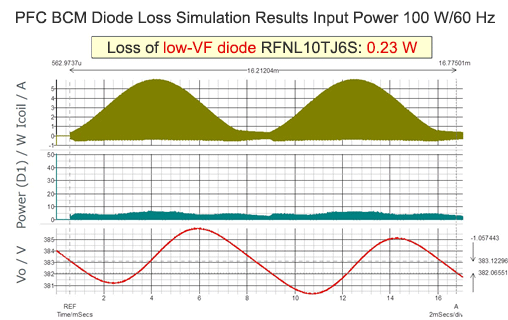
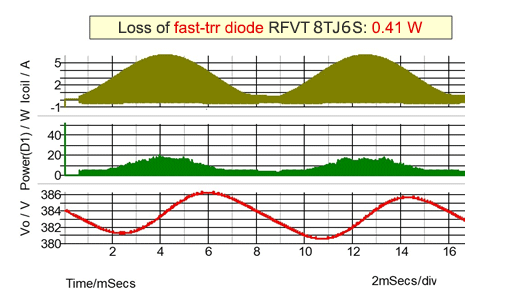
The waveforms in the center represent the diode loss power. The upper waveforms are the coil currents which are the diode currents IF, and the lower waveforms are the output voltage, or the voltage applied to the diodes. The diode loss power is as shown by the waveforms, and is lower for the low-VF diode RFNL10TJ6S. Average loss values are 0.23 W for the RFNL10TJ6S with low VF and standard trr, and 0.41 W for the RFV08TJ6S with fast trr and standard VF. The difference in VF values is 1.25 V versus 3 V (when IF = 8 A).
These results indicate that in boundary current mode PFC, differences in the diode VF have a major effect on losses, whereas the effect of trr is small. This is because in boundary current mode, currents from zero to peak value flow, and so if the diode VF is high, to this extent conduction losses will be increased.
In PFC under boundary current mode control, by selecting a diode with a low a VF as possible, circuit efficiency can be improved.
In the next article, we will explain the effect of diodes in continuous current mode (CCM).
【Download Documents】 Silicon Power Devices Application Examples Utilizing the Merits
ROHM’s seminar materials provided at the seminar venue. Silicon base power devices continue its evolution for the market demands of product power saving and efficiency enhancing. Basic knowledge to selection methods for diodes and MOSFETs, the latest device properties, and application examples are described.

Electrical Circuit Design
Basic
- Soldering Techniques and Solder Types
- Seven Tools for Soldering
- Seven Techniques for Printed Circuit Board Reworking
-
Basic Alternating Current (AC)
- AC Circuits: Alternating Current, Waveforms, and Formulas
- Complex Numbers in AC Circuit
- Electrical Reactance
- What is Impedance? AC Circuit Analysis and Design
- Resonant Circuits: Resonant Frequency and Q Factor
- RLC Circuit: Series and Parallel, Applied circuits
- What is AC Power? Active Power, Reactive Power, Apparent Power
- Power Factor: Calculation and Efficiency Improvement
- What is PFC?
- Boundary Current Mode (BCM) PFC: Examples of Efficiency Improvement Using Diodes
- Continuous Current Mode (CCM) PFC: Examples of Efficiency Improvement Using Diode
- LED Illumination Circuits:Example of Efficiency Improvement and Noise Reduction Using MOSFETs
- PFC Circuits for Air Conditioners:Example of Efficiency Improvement Using MOSFETs and Diodes
-
Basic Direct Current (DC)
- Ohm’s Law: Voltage, Current, and Resistance
- Electric Current and Voltage in DC Circuits
- Kirchhoff’s Circuit Laws
- What Is Mesh Analysis (Mesh Current Method)?
- What Is Nodal Analysis (Nodal Voltage Analysis)?
- What Is Thevenin’s Theorem?: DC Circuit Analysis
- Norton’s Theorem: Equivalent Circuit Analysis
- What Is the Superposition Theorem?
- What Is the Δ–Y Transformation (Y–Δ Transformation)?
- Voltage Divider Circuit
- Current Divider and the Current Divider Rule