
Transistors|Basic
Introduction
2016.09.08
Points of this article
・Understanding the features and characteristics of the latest Si power devices, to review and expand the coverage of Si power devices.
・Choosing between existing Si semiconductor devices and SiC power devices using new materials, according to the required specifications.
We will be adding new articles related to “power devices” to Tech Web’s “Basic Knowledge”. Recently, discrete devices such as diodes and transistors for handling large power with small loss, known as “power devices” or “power semiconductors”, have gathered attention. The reason is that power devices with higher efficiency and higher performance are needed to address “energy savings” and “miniaturization”, which are issues throughout the world.
However, what specific definitions should we use to categorize these “power devices” that one hears so much about today? Certainly there are no clear categories, but for example there are diodes and MOSFETs for AC-DC conversion or power switching with high voltage and high power, and then there are power modules that are modularized for output stages of power supply.
Here we will break things down into “silicon (Si) power devices” that are based on the conventional silicon semiconductor devices, and “silicon carbide (SiC) power devices” that have low loss and excellent characteristics in high-temperature environments compared to Si devices, and which are therefore expected to be the next generation low-loss elements. For power devices it is natural that attention is focused on new materials such as SiC, but there also are stunning performance improvements in the Si power devices that currently cover a wide range of markets and applications. At the present time one uses the best power devices according to the application and the specifications, so we will cover power devices in a rather wide sense.
Si Power Devices
We will break down our discussion of Si devices into four sections:
- Si Diodes
- Classification and Characteristics
- Schottky Barrier Diodes
- Fast Recovery Diodes
- Si Transistors
- Classification and Characteristics
- High-Voltage MOSFETs
- Methods of Selecting Transistors
- Selection Process
- SOA, Ratings, Temperature
- Application Examples with Special Characteristics

There are many types of Si diodes and MOSFETs, and they have a lot of variation with regard to voltage rating and current. Among these, we will mainly consider power supply applications, and with regard to Si diodes we will cover Schottky barrier diodes and fast recovery diodes. For MOSFETs we will concentrate on high-voltage super-junction MOSFETs.
We will introduce the procedures and the decision methods for selecting transistors based on the required specifications, giving application examples that make use of the characteristics of diodes and transistors.
For each of these we will include basic information. For a power supply of several tens of watts, the power device is incorporated in a power supply IC, and it has become rare to choose a separate MOSFET and verify its operation. However, it is important to master the use of discrete parts in a high-power circuit. Future articles will check again the characteristics and specification values of diodes and transistors, and they will provide an opportunity to learn about the latest Si power devices characteristics and performance.
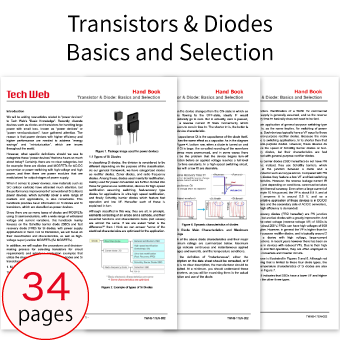
【Download Documents】 Transistors & Diodes Basics and Selection
In this handbook, although there are so many types of power devices using Si semiconductors, the basic points are explained, focusing mainly on diodes and transistors for power supply applications. It also introduces the procedure and decision method for transistor selection when designing circuits, as well as application examples that utilize each characteristic and feature.
Transistors
Basic
-
Basics of Transistors
- Transistor Fundamentals: Structure, Types, and Operating Principles
- Bipolar Junction Transistor (BJT) Basics: Operation and Applications (NPN & PNP)
- NPN Transistor: Low-Side Switch Fundamentals
- PNP Transistor: High-Side Switch Fundamentals
- MOSFET Basics: Parasitic Capacitance, Gate Charge, Miller Region, and Threshold Voltage
- MOSFET On-Resistance (RDS(on))
- Super junction MOSFET (SJ MOSFET) Basics
- What is a Digital Transistor?
- Digital Transistor Selection
- Low-Side Switch Design: NPN Transistor Circuit Design
- How to select<Selecting Transistors to Ensure Safe Operation>
- Junction Temperature <Calculating Transistor Chip Temperature>
- What is a Load Switch?
- Basics of MOSFETs
- Introduction
-
Confirming the Suitability of a Transistor in Actual Operation – Introduction
- Confirmation of the Chip Temperature
- Confirmation of Suitability in Actual Operation and Preparations
- Confirmation that Absolute Maximum Ratings are Satisfied
- Confirmation that Operation is within the SOA (Safe Operating Area)
- Confirmation that Operation is within the SOA Derated at the Actual Operating Temperature
- Confirmation that Average Power Consumption is within the Rated Power
- Summary
- Summary
Evaluation
-
The Importance of the Recovery Characteristics of Primary-side Switching Elements in LLC Converters -Introduction-
- Basic Configuration of an LLC Converter
- Features of LLC Converter Operation
- Basic Operation of LLC Converters
- Importance of MOSFET Recovery Characteristics for Off-Resonance of LLC Converters
- The Importance of the Recovery Characteristics of Primary-side Switching Elements in LLC Converters ーSummaryー
-
The Importance of the Reverse Recovery Characteristics of Switching Elements in Inverter Circuits -Introduction-
- Types of Inverter Circuits and Energization Methods
- Basic Operation of 3-Phase Modulation Inverter Circuits
- Comparison of Losses in a PrestoMOS™ MOSFET and a Standard SJ MOSFET Using Double-Pulse Tests (Actual Measurement Results)
- Comparison of Efficiency of a PrestoMOS™ MOSFET and a Standard SJ MOSFET in a 3-Phase Modulation Inverter Circuit (Simulations)
- The Importance of the Reverse Recovery Characteristics of Switching Elements in Inverter Circuits -Summary-
- Mechanisms of MOSFET Destruction
- About Double-Pulse Tests
-
Improving the Power Conversion Efficiency of Phase Shift Full Bridge Circuits – Introduction
- Basic Configuration of a PSFB Circuit
- Basic Operation of PSFB Circuits
- Guidelines Relating to Operation of Switching Elements Under Light Loading
- Guidelines Relating to Operation of Switching Elements Under Heavy Loading
- Evaluation of Efficiency
- Improving the Power Conversion Efficiency of Phase Shift Full Bridge Circuit – Summary –