
Transistors|Basic
Junction Temperature <Calculating Transistor Chip Temperature>
How to Calculate Junction Temperature (From Ambient Temperature)
Junction temperature (or channel temperature) can be calculated from the ambient using the following equation.

*Rth(j-a): Thermal resistance of “junction-to-ambient” varies depending on the type of circuit board. For reference, provided below is the Table of Thermal Resistance by Package”based on the use of ROHMs standard circuit board.
*Rth(j-a) value differs for each part number, but the values will be close if the package is the same.
**If the current consumption is not stable and changing time to time, then the averaged values of consumption current shall be assigned in the calculation formula to get the approximate value (See the “Usable or Not Judgement Method”.
Below is an example of the correlation between current consumption and the junction temperature when Rth (j-a) is 250 deg./W , the ambient temperature is 25 deg.

The junction temperature rises in proportion to the power dissipation.The proportionality constant for this is Rth(j-a).
Since Rth(j-a) is 250 deg./W, the junction temperature rises by 25 deg. per each increment of 0.1W of current consumption. This means, the junction temperature becomes 150 deg. when the current consumption is 0.5W, and the graph in this case suggests that the current beyond 0.5W can not be applied to TR.

When the same current is applied, the junction temperature also rises as the ambient temperature goes up. This diminishes the applicable current subsequently. Maximum power consumption is influenced by thermal resistance and the ambient temperature as well.

The maximum current consumption decreases with the above ratio.

The Derating curve above illustrates the ratio of current attenuation by percentage, which can be applied to all packages. For example, in case of the MPT3 package (SOT89), the maximum applicable power is 0.5W at 25 deg. and the applicable current is reducing at a rate of 0.8%/deg.
Transient Thermal Resistance
In the examples above, we discussed cases in which the current is applied to a device continuously. Next, we will discuss a case in which the temperature rises by momentary current application.

The graph above shows the thermal resistance at momentary time (Transient Thermal Resistance), plotting the pulse width on the X-axis and Rth(j-a) is on the Y-axis.
This graph shows us that the junction temperature rises as the current application time persists, reaching a plateau state (called thermal saturation) after 200 seconds.

We can use the calculation formula above to obtain the junction temperature when the current is applied momentarily as a single pulse, considering the critical role of thermal dissipation in managing heat within electronic components.
Calculation Method of Junction Temperature (From Case Temperature)
The junction temperature can be calculated from the core temperature of the case, as seen below. An example would be to replace Rth(j-a) in the formula with Rth(j-c).

* Case temperature is measured by the radiation thermometer, as the maximum temperature on the surface of the package, where the marking is put.
* Please note that the case temperature differs considerably depending on the measurement method/point.
** The value is considered an approximation when the applied current is not constant, shifting from time to time by assigning the averaged consumption figure.
Since the Rth(j-c) value varies depending on the types of circuit board and also on the heat dissipation conditions (which include soldering state), the formula above potentially wouldn’t apply to your calculation since the measured values on RHOMs circuit board may not be the same as the measured values on your circuit board. For instance, the case temperature could be lower in comparison even though the applied current is the same, when the circuit board has good heat dissipation characteristics.
An illustration below shows that Rth(j-c) becomes lower as the collector land pattern on the circuit board gets larger. Integrated circuits are particularly susceptible to heat-induced failures, making accurate measurement of junction temperature crucial to prevent decreased performance and ensure longevity. (Collector land area / thickness / materials plus circuit board material, size circuit width will also bring different measurement results on Rth(j-c).

The Rth(j-c) value can differ depending on the nature & conditions of the circuit board. It is difficult to choose the right location for measuring the case temperature precisely. Because of this, it is not recommended to approximate the junction temperature from the case temperature.
Junction-to-Case Thermal Resistance Rth(j-c) – Details
In principle, Junction-to-Case thermal resistance Rth(j-c) is an index basically used for TO220 packaged (through hole) devices by soldering it to the heatsink. This index is crucial for ensuring that the maximum junction temperature is not exceeded, as surpassing this limit can lead to permanent damage. In this case, since Case-to-Heatsink is the heat-radiation path, it is possible to precisely calculate the junction temperature by measuring the case temperature at the point in the middle of such path. In particular, if a heatsink with ideal heat dissipation performance is used (e.g. infinite heatsink), the heat dissipation capability is considered to be limitless. It is taken for granted that “Case temperature” = “Ambient temperature” , and Case temperature = 25 deg. (Tc = 25 deg.) is supplied in the calculation formula.
(Thermal resistance of infinite heat-sink : Rth(c-a) = ; then Rth(j-a) = Rth(j-c))

For surface-mount devices, the heat-radiation path is mainly the part of a circuit board that’s just beneath the device; which can make it quite difficult to measure the case temperature because of the location. Even if the temperature on marking side of device is measured, its portion of heat-dissipation in the entire heat-dissipation is rather small. Therefore, it is not suitable to use this temperature within the formula to calculate the junction temperature. Understanding thermal parameters is essential in these cases to ensure accurate thermal management.

Nevertheless, since there are many requests from our customers about Rth(j-c) value for SMT devices, ROHM sometimes provides the Rth(j-c) value on the conditions that the temperature is measured from the marking side of the device being mounted on the previously mentioned standard circuit board. Because of this, the Rth(j-c) value should be considered as a reference.
If the device is mounted on the circuit board in a different way from ours, the portion of heat-dissipation in the entire heat radiation will be different, making it hard to figure out the junction temperature accurately.
Thermal Resistance of Standard Packages (Reference Data)
The values in following data are not the guaranteed values nor maximum / minimum values. Please treat these only as reference data.*
* Data listed here came from the results of measuring a specific production lot.
* Rth ( j-a ) varies depending on the circuit board, the heat-dissipation conditions involving soldering methods and the method of temperature measurement.
| Package | VMT3 | EMT3 | EMT5 | EMT6 | TUMT3 |
|---|---|---|---|---|---|
| Circuit Board |  |
 |
 |
 |
 |
| FR4 dimensions (unit:mm) |
20×12×0.8 | 20×15×0.8 | 20×15×0.8 | 20×15×0.8 | 20×12×0.8 |
| Rth(j-a)/ Rth(ch-a) |
833℃ / W | 833℃ / W | 1042℃ / W | 1042℃ / W | 313℃ / W |
| Note | - | - | When driving 1-die | When driving 1-die | - |
| Package | TUMT6 | UMT3 | UMT5 | UMT6 | SMT3 |
|---|---|---|---|---|---|
| Circuit Board |  |
 |
 |
 |
 |
| FR4 dimensions (unit:mm) |
15×20×0.8 | 20×12×0.8 | 20×15×0.8 | 15×20×0.8 | 20×12×0.8 |
| Rth(j-a)/ Rth(ch-a) |
313℃ / W | 625℃ / W | 1042℃ / W | 1042℃ / W | 625℃ / W |
| Note | When driving 1-die | - | When driving 1-die | When driving 1-die | - |
| Package | SMT5 | SMT6 | TSMT3 | TSMT5 | TSMT6 |
|---|---|---|---|---|---|
| Circuit Board |  |
 |
 |
 |
 |
| FR4 dimensions (unit:mm) |
20×15×0.8 | 20×15×0.8 | 30×15×0.8 | 20×15×0.8 | 20×15×0.8 |
| Rth(j-a)/ Rth(ch-a) |
625℃ / W | 625℃ / W | 250℃ / W | 250℃ / W | 250℃ / W |
| Note | When driving 1-die | When driving 1-die | - | When driving 1-die | When driving 1-die |
| Package | SOP8 | MPT3 | CPT3 | SST3 | |
|---|---|---|---|---|---|
| Circuit Board |  |
 |
 |
 |
|
| FR4 dimensions (unit:mm) |
20×20×0.8 | 12×20×0.8 | 12×30×0.8 | 20×12×0.8 | |
| Rth(j-a)/ Rth(ch-a) |
160℃ / W | 250℃ / W | 125℃ / W | 625℃ / W | |
| Note | When driving 1-die | - | - | - |
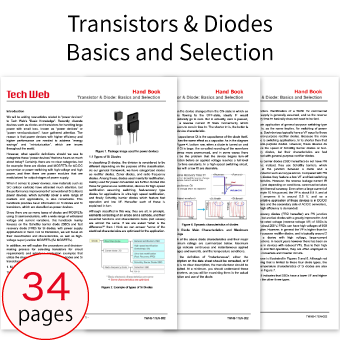
【Download Documents】 Transistors & Diodes Basics and Selection
In this handbook, although there are so many types of power devices using Si semiconductors, the basic points are explained, focusing mainly on diodes and transistors for power supply applications. It also introduces the procedure and decision method for transistor selection when designing circuits, as well as application examples that utilize each characteristic and feature.
Transistors
Basic
-
Basics of Transistors
- Transistor Fundamentals: Structure, Types, and Operating Principles
- Bipolar Junction Transistor (BJT) Basics: Operation and Applications (NPN & PNP)
- NPN Transistor: Low-Side Switch Fundamentals
- PNP Transistor: High-Side Switch Fundamentals
- MOSFET Basics: Parasitic Capacitance, Gate Charge, Miller Region, and Threshold Voltage
- MOSFET On-Resistance (RDS(on))
- Super junction MOSFET (SJ MOSFET) Basics
- What is a Digital Transistor?
- Digital Transistor Selection
- Low-Side Switch Design: NPN Transistor Circuit Design
- How to select<Selecting Transistors to Ensure Safe Operation>
- Junction Temperature <Calculating Transistor Chip Temperature>
- What is a Load Switch?
- Basics of MOSFETs
- Introduction
-
Confirming the Suitability of a Transistor in Actual Operation – Introduction
- Confirmation of the Chip Temperature
- Confirmation of Suitability in Actual Operation and Preparations
- Confirmation that Absolute Maximum Ratings are Satisfied
- Confirmation that Operation is within the SOA (Safe Operating Area)
- Confirmation that Operation is within the SOA Derated at the Actual Operating Temperature
- Confirmation that Average Power Consumption is within the Rated Power
- Summary
- Summary
Evaluation
-
The Importance of the Recovery Characteristics of Primary-side Switching Elements in LLC Converters -Introduction-
- Basic Configuration of an LLC Converter
- Features of LLC Converter Operation
- Basic Operation of LLC Converters
- Importance of MOSFET Recovery Characteristics for Off-Resonance of LLC Converters
- The Importance of the Recovery Characteristics of Primary-side Switching Elements in LLC Converters ーSummaryー
-
The Importance of the Reverse Recovery Characteristics of Switching Elements in Inverter Circuits -Introduction-
- Types of Inverter Circuits and Energization Methods
- Basic Operation of 3-Phase Modulation Inverter Circuits
- Comparison of Losses in a PrestoMOS™ MOSFET and a Standard SJ MOSFET Using Double-Pulse Tests (Actual Measurement Results)
- Comparison of Efficiency of a PrestoMOS™ MOSFET and a Standard SJ MOSFET in a 3-Phase Modulation Inverter Circuit (Simulations)
- The Importance of the Reverse Recovery Characteristics of Switching Elements in Inverter Circuits -Summary-
- Mechanisms of MOSFET Destruction
- About Double-Pulse Tests
-
Improving the Power Conversion Efficiency of Phase Shift Full Bridge Circuits – Introduction
- Basic Configuration of a PSFB Circuit
- Basic Operation of PSFB Circuits
- Guidelines Relating to Operation of Switching Elements Under Light Loading
- Guidelines Relating to Operation of Switching Elements Under Heavy Loading
- Evaluation of Efficiency
- Improving the Power Conversion Efficiency of Phase Shift Full Bridge Circuit – Summary –